SOLAR STATION LIVE
SOLAR STATION Live – manual
SOLAR STATION Live is designed to connect to your inverter automatically, without any manual configuration.
If SOLAR STATION Live does not find a compatible WiFi network, it will show a selection menu with all available WiFi networks. Select your inverter's network.
Select the correct inverter and enter the WiFi password if required. SOLAR STATION Live stores the password and reconnects automatically next time.
Firmware update SOLAR STATION Live
Tip: Firmware updates bring new features and support for additional inverters. If SOLAR STATION Live is working without issues, you can stay on the current version – you won't miss anything critical.
First, check which version of SOLAR STATION Live you have. The version number (e.g. 123) is shown on the startup screen in the bottom left corner.
What you will need
- Computer – Windows, macOS or Linux
- USB-C cable – must be a data cable (not charging-only)
- Browser – Chrome or Microsoft Edge
Update procedure
- Connect SOLAR STATION Live to your computer using a USB-C cable.
- Open the update page for your generation and click the Connect button:
- 1st generation (4 screws on the back): Update here
- 2nd generation (no screws on the back): Update here
- In the dialog, select the serial port (usually contains "usb serial").
- Choose Install Solar Station Live and wait for completion (a few minutes).
- Once finished, SOLAR STATION Live is ready to use.
Displayed data
The display of SOLAR STATION Live is divided into clear sections. The following image shows the main screen layout:
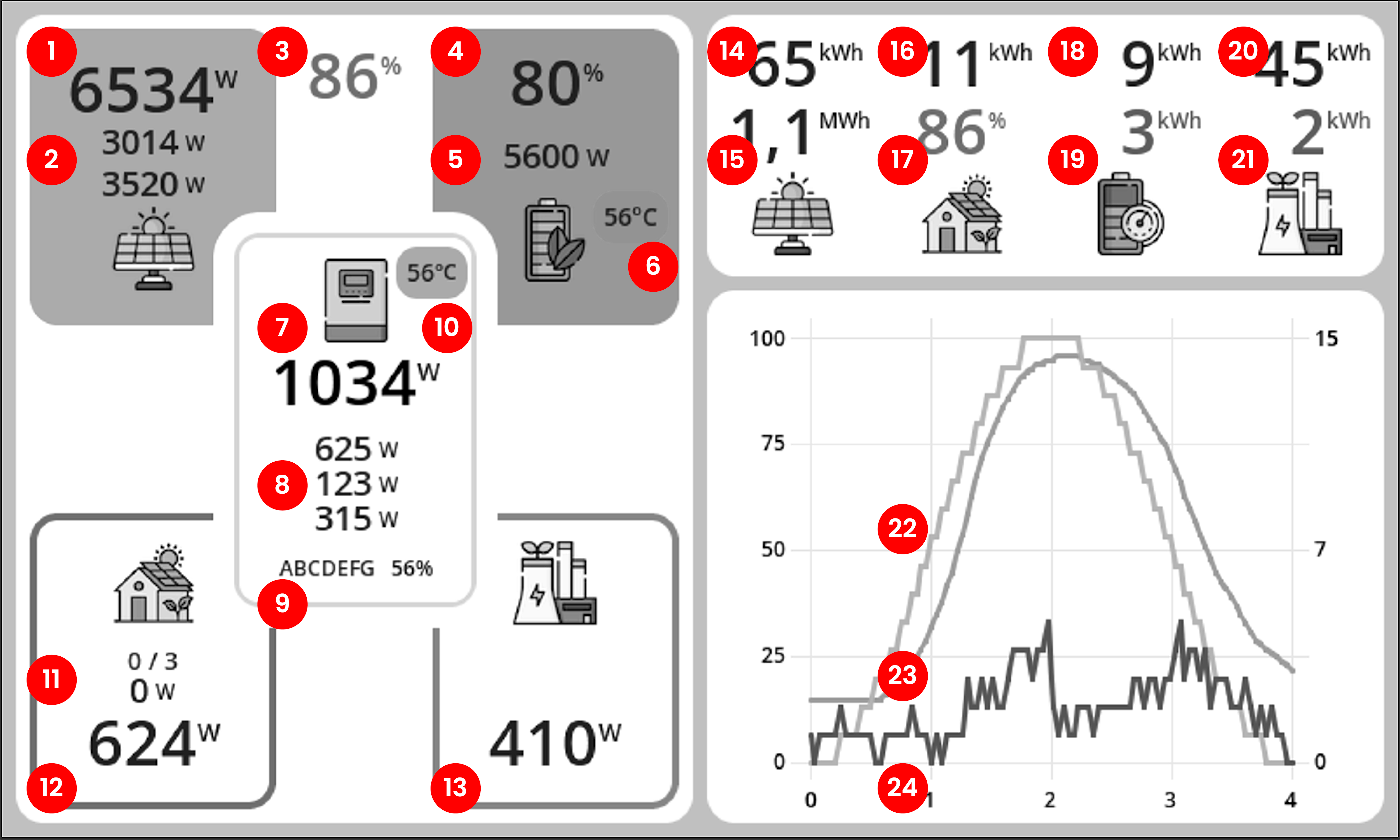
- Current PV array output
- String power (if available)
- Self-consumption ratio from solar energy
- Battery state of charge
- Battery charging/discharging power
- Battery temperature
- Total inverter power
- Load on each inverter phase (overloaded phase highlighted in red). A negative value indicates reverse power flow – typically when the battery is charged from the grid.
- Inverter serial number and WiFi signal strength
- Inverter temperature
- Number of active and paired SOLAR PLUG sockets (total power of switched-on sockets)
- Total household consumption
- Power imported from and exported to the grid
- Today’s PV production
- Total production since installation
- Today’s electricity consumption
- Today’s self-consumption ratio
- Today’s energy stored into the battery
- Today’s energy taken from the battery
- Today’s export to the grid
- Today’s import from the grid
- Graph of PV production (yellow), battery state of charge (blue) and household consumption (green).
Some daily statistics show zeros after startup for certain inverters (Victron, GoodWe). This is because the inverter does not provide these daily counters. SOLAR STATION Live calculates them itself from total counters, so they become valid after midnight.
Connection to inverter
The station connects automatically if it finds exactly one supported dongle and has all required credentials. After a restart it will restore the connection by itself.
If the station cannot decide which device to use, or the connection fails, a configuration screen is shown.
The station can connect directly to the inverter dongle WiFi, or it can join your home WiFi and find the inverter there (or use a manually entered IP address).
Direct connection
The station connects directly to the WiFi network broadcast by the inverter dongle. The table below shows what to fill in for each inverter type.
| Connection | WiFi | Password | IP | Serial number |
|---|---|---|---|---|
| Solax | Wifi_XXXXXX | Leave empty | Leave empty | Ignored |
| GoodWe | Solar-WiFi-XXXXXX | Default: 12345678 | Leave empty | Ignored |
| Victron | venus-XXXXXX | On dongle label | Leave empty | Ignored |
| Sofar | AP_XXXXXX | On dongle label | Leave empty | Dongle SN: XXXXXX |
| DEYE | AP_XXXXXX | On dongle label | Leave empty | Dongle SN: XXXXXX |
| GROWATT (SPH/SPA, MIN-XH/MID-XH/MOD-XH, MIN/MIX) | XGD-XXXXXX | Default: 12345678 | Leave empty | Ignored |
Connection via home WiFi
If you want to connect the station to your home WiFi network, enter the network name and password. The station will join your home network and then find the inverter there (or use the IP address you enter).
The table below shows what to fill in for each inverter.
| Connection | WiFi | Password | Inverter IP | Inverter SN |
|---|---|---|---|---|
| Solax | Your WiFi | Your password | Leave empty or enter IP | Ignored |
| GoodWe | Your WiFi | Your password | Leave empty or enter IP | Ignored |
| Victron | Your WiFi | Your password | Leave empty or enter IP | Ignored |
| Sofar | Your WiFi | Your password | Leave empty or enter IP | Dongle SN (XXXXXX from AP_XXXXXX), used as password |
| DEYE | Your WiFi | Your password | Leave empty or enter IP | Dongle SN (XXXXXX from AP_XXXXXX), used as password |
| GROWATT (SPH/SPA, MIN-XH/MID-XH/MOD-XH, MIN/MIX) | Your WiFi | Your password | Enter IP address (find it in your router) | Leave empty |
Supported inverters
SOLAX
SOLAR STATION Live usually connects to SOLAX automatically with default settings. If it does not, follow these steps:
- Check if the WiFi network Wifi_XXXXXX (dongle WiFi) is visible. If not, it might be hidden – disable SSID hiding in the SOLAX Cloud mobile app (Menu → Settings → Network → Pocket WiFi SSID Broadcast).
- The dongle WiFi is open (no WiFi password), but the API access is protected. The default API password is printed on the dongle label and starts with the letter “S”.
GOODWE
- Check that WiFi network Solar-WiFi-XXXXXX (XXXXXX = dongle serial number) is visible. The default password is 12345678.
- If the dongle is not visible, press the dongle button briefly (1 s) to reset it and wait about 3 minutes for it to restart.
VICTRON
Victron broadcasts a WiFi network venus-XXXXXX (XXXXXX = device serial). The password is printed on the label.
For proper operation you must enable Modbus TCP in the menu (Menu → Settings → Services → Modbus TCP).
SOFAR
Sofar inverter broadcasts a WiFi network AP_XXXXXX (XXXXXX = dongle serial number). The password is printed on the dongle label.
You must enter the dongle serial number (XXXXXX from the WiFi network name AP_XXXXXX). The station communicates via V5TCP protocol on port 8899.
GROWATT
We support three Growatt families — the inverter type is detected automatically on the first connection, no manual switch is needed:
- SPH / SPA – hybrid inverters with battery, single- (SPH 3000–10000) and three-phase (SPH TL3 BH-UP, SPA);
- MIN-XH / MID-XH / MOD-XH (TL-XH) – the newer hybrid generation with battery;
- MIN / MIX (TL3-X) – classic non-hybrid string inverters without battery.
You must update the firmware of your Shine WiFi-X dongle. Firmware version 3.1.1.1 or newer is required, with Modbus TCP enabled. With older firmware the station will not work.
The update is done via the ShinePhone app. Proceed as if you were changing the WiFi network for the dongle. During the process, the app will offer a firmware update – confirm it. Video tutorial (YouTube).
Unfortunately, the WiFi dongle does not provide any auto-discovery for its IP address in your LAN, unlike some other inverters. You must enter the IP of your Shine WiFi-X dongle into the station manually. You can find it in your router device list – it usually appears as a device named “Espressif”.
SOLAR PLUG
SOLAR STATION Live creates its own WiFi network (SoftAP) to which the sockets connect. The sockets communicate exclusively with the station – they are not available in the Shelly cloud, the Shelly app, or any other network. The station is the sole controller of the sockets.
Supported sockets
| Model | WiFi prefix (during pairing) |
|---|---|
| Shelly Plug S | shellyplug-s- |
| Shelly Plug | shellyplug- |
| Shelly Plus Plug S | ShellyPlusPlugS- / PlusPlugS- |
| Shelly Plug S Gen3 | ShellyPlugSG3- |
| Shelly Plug M Gen3 | ShellyPlugMG3- |
| Shelly Pro 1PM | ShellyPro1PM- / Pro1PM- |
| Shelly Plus 1PM | ShellyPlus1PM- / Plus1PM- |
| Shelly 1PM Gen3 | Shelly1PMG3- |
| Shelly Pro 3 | ShellyPro3- / Pro3- |
| Shelly Pro Dimmer 1PM | ShellyProDM1PM- |
| Shelly Dimmer Gen3 | Shelly0110DimG3- |
| Shelly 1 Mini Gen3 | Shelly1MiniG3- |
Pairing
On first power-up, the socket enters pairing mode – it broadcasts an open WiFi network with the prefix listed above. You can trigger pairing at any time by holding the button on the socket for 10 seconds (the blue LED will light up).
SOLAR STATION Live automatically searches for these WiFi networks, connects to the socket and configures it to join the station's own network (SoftAP). During configuration, the LED colour indicates the state:
- Blue: pairing mode active
- Red: configuration in progress
- Orange: device successfully configured and active
After successful pairing, the socket appears in the household consumption tile. Up to 8 sockets can be connected to the station.
Socket switching
SOLAR STATION Live controls sockets automatically according to internal rules. No manual configuration is required. The energy balance is monitored and the home battery is prioritised. As soon as the battery is charged and/or there are PV surpluses, the station starts switching sockets on in a cascade. Each socket stays on for at least 5 minutes.
You can turn the socket on manually with its button – in that case automatic control is temporarily disabled. To re-enable automatic control, simply turn the socket off with the button again.
With a socket switched on, some power may be taken from the battery, but never for more than the 5-minute minimum. In borderline PV conditions the station will cycle sockets on and off to maximise the use of PV energy.
EcoVolter PRO (2nd generation)
EcoVolter PRO (2nd generation) is fully compatible with SOLAR STATION Live.
Dynamic charging power control – SMART mode – is supported.
SOLAR STATION Live will find EcoVolter PRO automatically if both are connected to the same WiFi network. For this you must have the station connected to your inverter via your home WiFi.
After pairing ECOVOLTER PRO (2nd generation), a new tile appears on the display with a switch. When you enable SMART mode on this tile, the station automatically optimises charging power according to the current household energy balance.
In SMART mode some battery energy may be used for charging, but at least 80 % of your home battery capacity is always kept in reserve.
Solax Wallbox
Solax Wallbox is fully compatible with SOLAR STATION Live.
Dynamic charging power control – SMART mode – is supported.
SOLAR STATION Live will find the Solax Wallbox automatically if both are connected to the same WiFi network. For this you must have the station connected to your inverter via your home WiFi.
After pairing with the Solax Wallbox, a new tile appears on the display with a switch. When you enable SMART mode on this tile, the station automatically optimises charging power according to the current household energy balance.
In SMART mode some battery energy may be used for charging, but at least 80 % of your home battery capacity is always kept in reserve.
Intelligence BETA
The station can automatically switch inverter modes based on current spot electricity prices, predicted production and consumption, optimising the economic benefit of your PV system — buying energy during cheap hours, selling during expensive ones, or arbitrage.
For an in-depth explanation of the internal algorithms see the dedicated document on Intelligence; below is a practical setup guide.
Currently supported inverters: Solax (hybrid Gen 4 and newer, WiFi dongle), GoodWe ET (1st generation), Sofar Solar HYD.
Activation
- Tap the eye icon in the top-right corner, or tap the inverter tile → INTELLIGENCE.
- Fill in battery parameters and prices (below) and press Save.
On first open, reasonable defaults are pre-filled for a typical Central-European tariff. You can restore them anytime with the Reset button.
Battery settings
- Battery cost per kWh — the cost of one charge/discharge cycle of 1 kWh. Calculate as purchase price ÷ (capacity × cycle count). Typically 0.06–0.10 €/kWh.
- Min / Max SOC — lower and upper charge limits (typically 10 % and 95 %).
- Capacity / Max charge / Max discharge — usually auto-detected from the inverter; override if needed.
Buy and Sell price
The price is always stored as a linear formula price = K × spot + Q. You enter it in one of three modes (separately for buy and sell):
- Spot (default) — for buy you enter VAT % (e.g. 21) and per-kWh fee (e.g. 2.50). For sell you enter buy-back % (e.g. 100) and fee (e.g. 0.50). The app computes K and Q.
- Fixed — a fixed per-kWh price (e.g. 4.00). The spot price is ignored.
- Custom — enter K and Q directly. For advanced users with unusual tariff structures.
Default for buy: Spot, VAT 21 %, fee 2.50 per kWh. Default for sell: Spot, 100 % of spot minus 0.50 per kWh fee (matches most current Czech/EU buy-back schemes).
Tariff exceptions (HT/LT)
If you have a two-rate tariff or a special price for a portion of the day, add an exception using the + Add button. Each exception specifies:
- Type — Buy / Sell (which price the exception overrides)
- Mode — Spot / Fixed / Custom (same as for the main price)
- From–To — time range in 15-minute steps
- Applies to — All days / Workdays / Weekend / Saturday / Sunday
- Value(s) according to the selected mode
Up to 8 exceptions in total. Example: a low tariff 22:00–06:00 on workdays — Buy / Spot / 22:00–06:00 / Workdays / VAT 21 % / Fee 0.05.
Manual override and status indication
Even with Intelligence active, you can always switch the inverter mode manually by tapping the inverter tile:
- INTELLIGENCE (blue badge) — automatic control
- NORMAL (green) — Self-Use without optimisation
- CHARGE (red) — forced charging from grid
- DISCHARGE (blue) — forced discharging to grid
- HOLD (grey) — battery held
While Intelligence is active, a plan tile is shown with the current mode and estimated daily savings. Tapping it reveals the detail — a list of upcoming mode changes with times and reasons.
Note: Intelligence only changes the inverter's work mode (Self-Use / Manual Charge / Manual Discharge / Manual Stop). It does not modify power limits, protection settings or battery configuration. The feature is still in beta — use at your own risk.
Feed-in limiter NEW
The Feed-in limiter feature automatically adjusts the maximum power delivered to the grid (export) based on the current spot electricity price. It is especially useful during hours with negative prices when exporting to the grid is not worthwhile.
Currently supported on Solax, GoodWe, Deye and Sofar inverters. The station must be connected to the inverter directly via its WiFi dongle. For Sofar the export limit is binary (allowed / blocked) because the inverter does not have a continuous export-power register; for the other brands the configured power limit (W) is applied.
Setup
- From the main screen open Wi-Fi Setup and find the Feed-in limiter card in the middle column (next to the inverter card). The card is shown only for supported inverters.
- Toggle the switch to enable the feature.
- Enter the price threshold (default 0). When the spot price is below this threshold, the “negative price” limit is applied.
- Enter the power at positive price in W (default 1000). This value sets the export limit when the price is above the threshold.
- Enter the power at negative price in W (default 0). This value sets the export limit when the price is below the threshold (typically 0 W = export fully stopped).
- Press Save.
Status visualisation
A coloured badge is shown on the Grid tile in the main dashboard:
- Green – export is allowed (current limit > 0 W).
- Orange – export is currently limited (limit set to 0 W).
The station automatically checks the price at every quarter change and immediately updates the inverter settings when needed.


